

Budapest, Ungarn
Mahnmal zur Erinnerung an die ungarische Revolution 1956 und die "Pester Jungs"
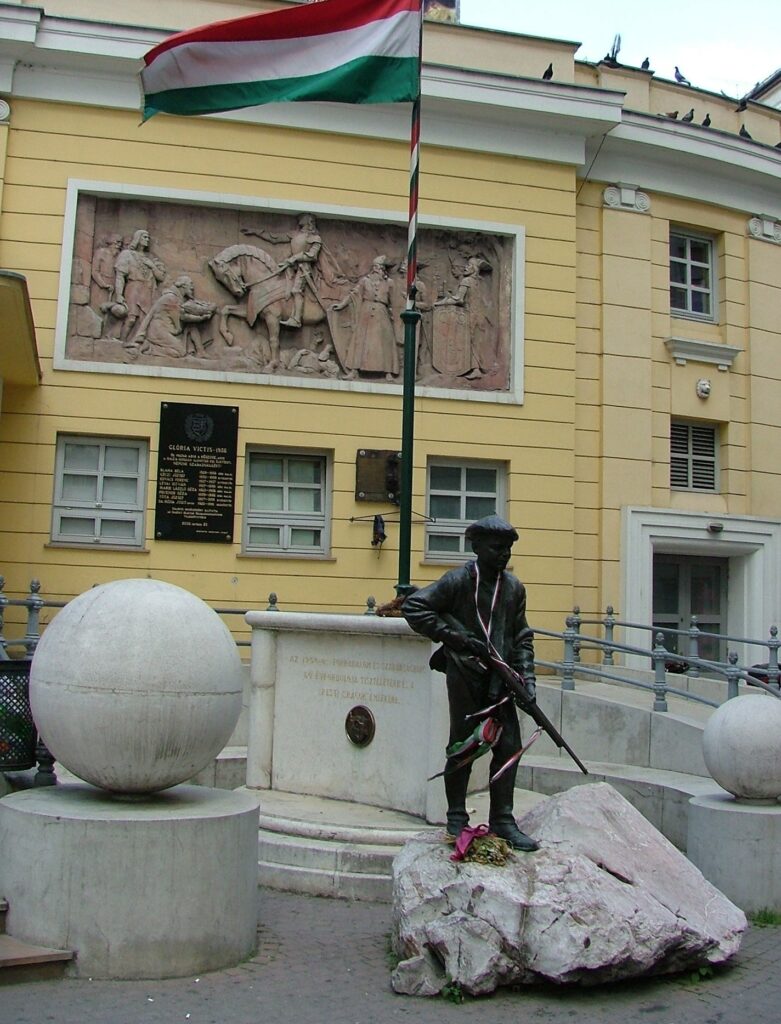
Das Mahnmal zur Erinnerung an die ungarische Revolution 1956 und die "Pester Jungs" wurde am 20. Oktober 1996 neben dem Corvin Kino eingeweiht. Es wurde von Zsolt Gláscy-Horváth geschaffen. Auf einem runden Sockel ist ein etwa anderthalb Meter hoher dreieckiger Aufbau zu sehen, in dem ein Fahnenmast in den ungarischen Nationalfarben eingelassen wurde. Auf dem Sockel befindet sich eine Bronzeplakette, die die Nationalfahne mit dem Kossuthwappen zeigt.
Das Corvin-Kino auf dem gleichnamigen Platz war eines der bekanntesten und größten Widerstandszentren in Budapest während der Revolution 1956. 1923 erbaut, befindet sich das Gebäude auf der Rückseite eines großen Häuserblocks, der an der Kreuzung der wichtigen Ausfallstrassen Ullői út und des Großen Rings (Nagykörut) steht. Der Platz ist nur durch schmale Durchgänge erreichbar und bot mit der dahinter gelegenen Schule und einer Tankstelle günstige strategische Vorraussetzungen für die Kontrolle der davor verlaufenden Strassen. Bereits am 23./24. Oktober 1956 sammelten sich hier erste Gruppen von Aufständischen, denen es gelang, aus der gegenüberliegenden Kilián-Kaserne Waffen zu erbeuten. Anführer wurde László Iván Kovács, der die Kämpfe mit den sowjetischen Truppen und den ungarischen Armeeeinheiten in den ersten Tagen der Revolution führte. Waren zu diesem Zeitpunkt gerade einmal etwa 40 bis 50 Aufständische in die Kämpfe verwickelt, stieg deren Zahl in den letzten Oktobertagen auf über eintausend an. Die Kämpfer entstammten meist dem einfachen Arbeiter- und Handwerkermilieu der umliegenden Wohnviertel. Etwa ein Drittel von ihnen war in der Nachkriegszeit in Konflikt mit dem stalinistischen Regime geraten und hatte aufgrund verschiedener Delikte Gefängnisstrafen verbüßt. Die überwiegende Mehrheit der Widerstandskämpfer waren zudem Jugendliche, deren Kampf gegen die sowjetischen Truppen wesentlich zur Entstehung des Mythos um den Corvin köz beitrug. Die Bewaffnung der Aufständischen beschränkte sich auf einige leichtere Handfeuerwaffen, so dass vor allem selbst gefertigte Molotowcocktails im Kampf gegen die Panzerfahrzeuge der ungarischen und sowjetischen Armee eingesetzt wurden. Nach dem Waffenstillstand am 28. Oktober 1956 nahmen die Aufständischen Kontakt mit Pál Maléter in der Kilián-Kaserne auf. In den folgenden Tagen nahmen Delegationen des Corvin köz an allen wichtigen Verhandlungen mit der Nagy-Regierung und der Armeeführung teil. Obwohl zwischen den Aufständischen und der Führung der Armee- und Sicherheitskräfte starkes Misstrauen herrschte, wurden die bewaffneten Gruppen Teil der in Bildung begriffenen Nationalgarde, behielten jedoch ihre Eigenständigkeit. Aufgrund der Bedeutung der Gruppe gewannen deren Anführer auch Einfluss auf die anderen Widerstandszentren im VIII. und IX. Stadtbezirk. Während der Feuerpause wurde am 30. Oktober, nach anderen Angaben am 1. November, Lászlo Iván Kovács abgesetzt und Gergely Pongrátz nach internen Auseinandersetzungen zum Anführer des Corvin köz berufen. Zeitgleich begann eine aus Aufständischen gebildete Miliz mit der Verhaftung von ÁHV- und Parteifunktionären, die in der Schule festgehalten wurden. Als am Morgen des 4. November 1956 der zweite sowjetische Einmarsch begann, war das Corvin köz eines der vorrangigen Ziele der Interventionstruppen. In den Abendstunden begann ein Großangriff der sowjetischen Truppen, bei dem die Wohnblock und das Kino schwer beschädigt wurden. Der Corvin köz musste so noch am gleichen aufgegeben werden. Teile der Aufständischen setzten ihren Kampf in anderen Teilen der Stadt noch einige Tage fort, während andere flohen oder sich vor den einrückenden Truppen zu verstecken versuchten. Gergely Pongrátz gelang die Flucht in den Westen, während László Iván Kovács verhaftet und hingerichtet wurde.
Übersetzung (Englisch)
Monument Commemorating the Revolution and the „Boys of Pest“
The monument commemorating the 1956 Hungarian Revolution and the „Boys of Pest“ near the Corvin Cinema was dedicated on October 20, 1996. It was created by Zsolt Gláscy-Horváth. On one rounded plinth, there is a triangular construction one and a half metres high into which a flag mast in the Hungarian national colours has been mounted. On the plinth, there is a bronze plaque showing the national flag with the Kossuth coat-of-arms.
The Corvin Cinema – located at the Square of the same name – was one of the best known and largest centres of resistance during the 1956 Revolution. Built in 1923, the building is situated to the rear of a large block of houses situated at the intersection of the important arterial roads Ullői Drive and the Great Ring (Nagykörut). The Square is only accessible by way of narrow transit routes, and thus – with a school located behind it and a petrol station - offered favourable conditions for gaining control over the streets running in front of it. As early as October 24/24, 1956, the first groups of insurgents gathered here who had been successful in confiscating weapons from the Kilián Barracks located on the opposite side. Lászlo Iván Kovács became the commander, who then led the battles against the Soviet troops and the Hungarian Army units during the initial days of the Revolution. Even though hardly 40 to 50 insurgents had become involved in the skirmishes at that time, their numbers soon rose to over one thousand during the final days of October. The rebels were usually from the workmen's and craftsmen's milieu in the surrounding residential areas. Approximately one-third of them had come into conflict with the post-war Stalinist regime and had served time in prison for various offences. The large majority of the resistance fighters also happened to be youngsters, and their battle against Soviet troops became an essential element in the myths surrounding Corvin köz. The armament of the insurgents was limited to several lighter handguns, and thus self-made Molotov cocktails were the main weapons used against the armoured vehicles of the Hungarian and Soviet armies. Following the cease-fire of October 28, 1956, the insurgents established contact with Pál Maléter at the Kilián Barracks. During the coming days, delegations from Corvin köz took part in all important negotiations with the Nagy government and the Army leadership. Although great distrust existed between the insurgents and the leadership of the Army and security forces, the armed contingent became part of the newly forming National Guard, while maintaining their autonomy at the same time. Due to the significance of the group, their leaders also gained considerable influence over the centres of resistance in the 8th and 9th Municipal Districts. In the midst of the cease-fire, on October 30th – and according to other reports November 1st -, Lászlo Iván Kovács was replaced divested of his command replaced by Gergely Pongrátz as leader of Corvin köz . At the same time, a new militia consisting of insurgents had begun arresting ÁHV and Party functionaries and imprisoning them in the school building. As the second invasion of Soviet troops advanced into the city on November 4, 1956, Corvin köz was one of the primary objectives for the intervention forces. during the evening hours, a massive attack was launched by Soviet troops which severely damaged the residential block and the cinema. Corvin köz had to be abandoned on the same day as a result. Some of the insurgents continued their struggle in other parts of the city for several days, others fled or attempted to hide from the advancing forces. Gergely Pongrátz managed to escape to the west, but Lászlo Iván Kovács was arrested and executed.
Verwandte Gedenkorte
- Gedenktafel für die Aufständischen des Corvin köz
- Gedenktafel für die Aufständischen des Corvin köz
- Gedenktafel für die Aufständischen des Corvin köz
- Gedenktafel für die gefallenen Aufständischen des Corvin köz
- Gedenktafel für Ilona Szabó
- Gedenktafel für Janós Mész
- Gedenktafel für László Bányai, Jószef Batta, Mihály Hoká und Dr. Janós Holyos
- Gedenktafel für László Iván Kovács
- Gedenktafel für Péter Renner, Imre Sörös und László Zsigmond
- Gedenktafel für Povl Bang Jensen
- Gedenktafel für Tibor Dömötör, Imre Gábor und János Szakály
- Gedenktafel Gloria Victis
- Mahnmal "Pester Junge"
Inschriften
Inschrift des Mahnmals
(auf dem Sockel)
AZ 1956-OS FORRADALOM ÉS SZABADSAGHARC / 40. ÉVFORDULÒJA TISZTELETÉRE ÉS A / PESTI SRÁCOK EMLÈKÉRE
Deutsche Übersetzung:
Zum 40. Jahrestag der Revolution und des Freiheitskampfes und zur Erinnerung an die Pester Jungs
Zum 40. Jahrestag der Revolution und des Freiheitskampfes und zur Erinnerung an die Pester Jungs
Englische Übersetzung:
For the 40th Anniversary of the Revolution and the Fight for Freedom and in memory of the Boys of Pest.
For the 40th Anniversary of the Revolution and the Fight for Freedom and in memory of the Boys of Pest.
Sprache: Ungarisch, Schrift: Lateinisch
Ereignisse
26. Oktober 1996 - Einweihung
Einweihung des Mahnmal zur Erinnerung an die ungarische Revolution 1956 und die "Pester Jungs"
Literatur
- 1956 enciklopédiája. A magyar forradalom és szabadságharc. 1956 október 6.- december 12, hrsg. vom 1956-os Intézet (1956-er Institut), Budapest 1999. 1 CD-ROM
- Eörsi, László: Corvinisták 1956. A VIII. kerület fegyveres csoportjai, Budapest 2001
- Géza, Boros: Emlékművek '56-nak. Budapest 1997
- Dent, Bob: Budapest 1956. Locations of Drama, Budapest 2006
- Kategorie: Gedenkort
- Historisch: Ja
- Standort: Corvin köz 1
- Stadt: Budapest
- Ortsteil: VIII. Stadtbezirk
- Land: Ungarn
