

Budapest, Ungarn
Mahnmale zur Erinnerung an die Opfer des Széna Platzes 1956
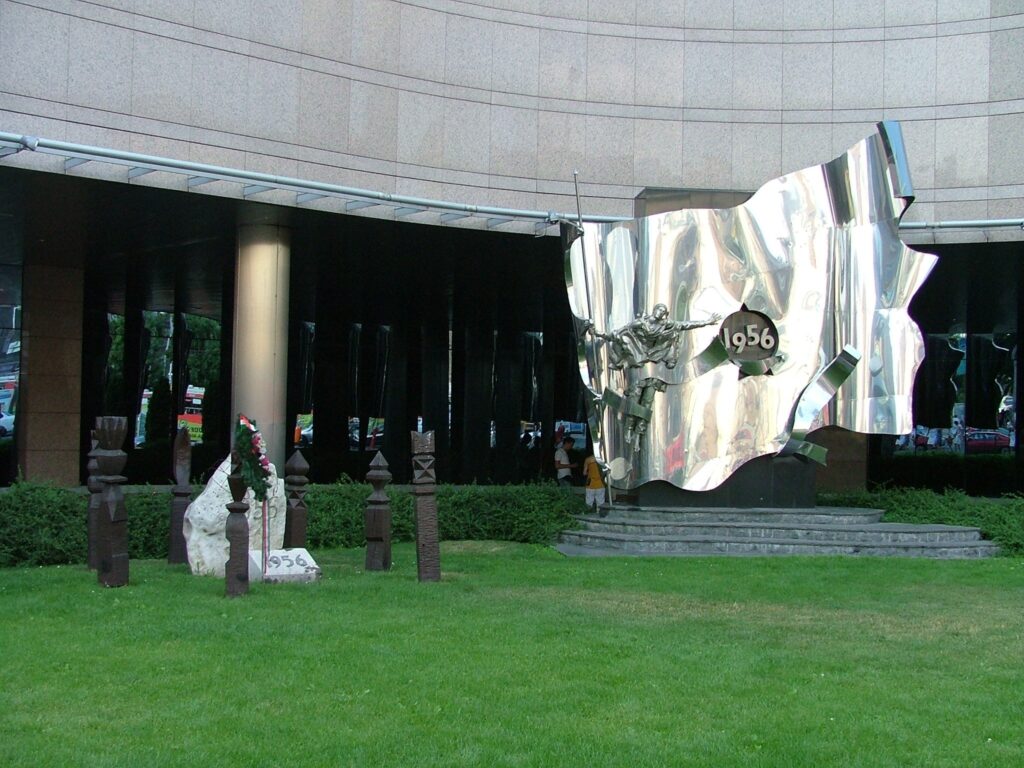
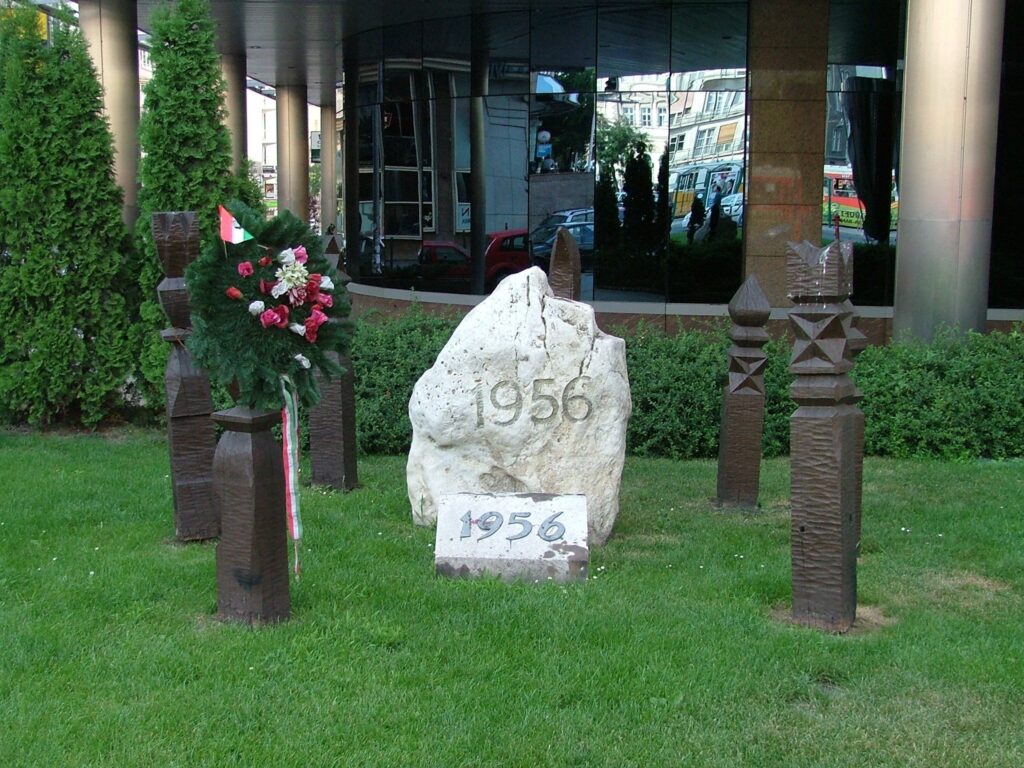
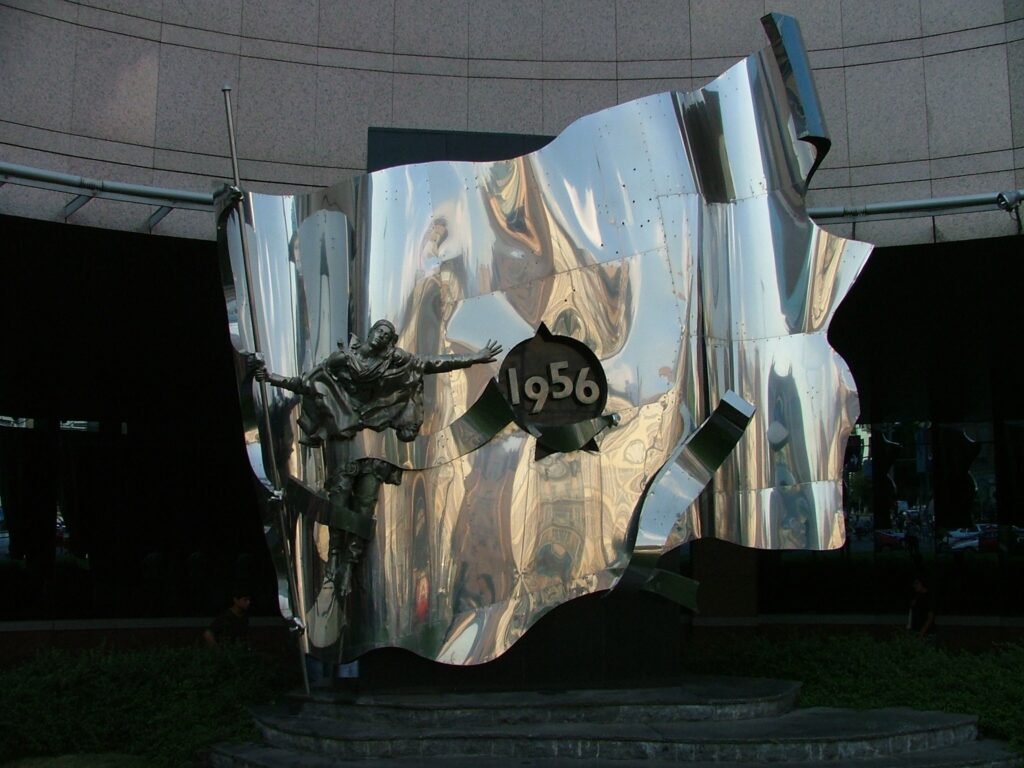
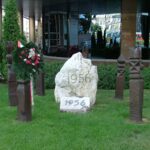
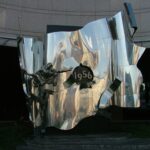
Die Mahnmale zur Erinnerung an die Kämpfe auf dem Széna Platz entstanden seit 1989. Im Herbst jenes Jahres, als das Gedenken an die Revolution erstmals offiziell zugelassen worden war, errichteten ehemalige Teilnehmer der Kämpfe sieben Kopfhölzer zu Erinnerung an ihre gefallenen Kameraden. Am 23. Oktober 1991 kam ein weißer Gedenkstein hinzu, dessen Inschrift auf die Geschichte des Platzes während der Revolution verweist. Mitte der 1990er Jahre begann der Bau der heute hier stehenden Einkaufkomplexe, der von heftigen Protesten begleitet wurde. Vor allem die Veteranenverbände wehrten sich gegen die Überbauung des historischen Ortes. Als Kompromiss wurde bei Fertigstellung 2001 ein weiteres Mahnmal in Form einer wehenden Nationalfahne aus poliertem Stahl errichtet. In deren Mitte ist die Jahreszahl „1956“ zu sehen. Gehalten wird die Fahne von einem stilisierten Aufständischen in heroischer Pose.
Die Widerstandsgruppe auf dem Széna-Platz ist neben den Aufständischen des Corvin köz eine der größten und bekanntesten der Revolution 1956. Benannt ist sie nach einem der wichtigsten Verkehrsknotenpunkte in Budapest. Bereits während der Belagerung der Stadt durch die Rote Armee 1944/45 tobten aufgrund der strategischen Bedeutung heftige Kämpfe um den Ort, die sich 1956 wiederholen sollten. Am 24./25. Oktober 1956 schlossen sich um den Széna-Platz die ersten Aufständischen zusammen und begannen in den umliegenden Strassen den bewaffneten Widerstand zu organisieren. Ein wichtiger Stützpunkt waren die Bauschächte für die geplante Metro-Linie am Széna-Platz, später die Kaserne des ungarischen Staatssicherheitsdienstes ÁHV, die nach Auseinandersetzungen in den letzten Oktobertagen eingenommen werden konnte. Die Kreuzung wurde mit Autos und umgestürzten Straßenbahnwagen blockiert. In den umliegenden Häusern bezogen die Aufständischen Stellung und hatten damit die Kontrolle über den Platz gewonnen. Zum Anführer avancierte János Szábo, der als „Onkel Szábo“ als einer der bekanntesten Widerstandskämpfer in die Geschichte der Revolution einging.
Die Kämpfe zwischen den Aufständischen und der ungarischen Armee sowie den sowjetischen Truppen dauerten am Széna-Platz bis zum 28. Oktober, dem Tag der Verkündung des Waffenstillstandes, an. Noch am Morgen des gleichen Tages versuchten ungarische Truppen zusammen mit sowjetischen Verbänden den Platz zu stürmen, nachdem die ersten Verhandlungen mit den Aufständischen über ein Ende der Kämpfe gescheitert waren. Ein Abkommen zwischen den Aufständischen und der den hier eingesetzten Truppen brachte am 29. Oktober eine Feuerpause. In den folgenden Tagen kooperierten die Aufständischen mit den Einheiten der ungarischen Armee, die wiederum zum Teil die Ausbildung der jungen Kämpfer übernahmen. Teile der bewaffneten Einheiten schlossen sich der am 30. Oktober gebildeten Nationalgarde an. Während der Waffenruhe wurden die wichtigen strategischen Gebäude des Stadtteils besetzt, so das Parteikomitee, das Amt für Statistik sowie Wohnhäuser geflohener Parteifunktionäre. Zum neuen Hauptquartier wurde die bereits erwähnte Kaserne der ÁHV auserwählt. Zum einem Zwischenfall kam es am 2. November, als eine Gruppe von Aufständischen aufgrund falscher Informationen das nahe gelegene Außenministerium stürmte. Erst nach Intervention von Bela Király, Verteidigungsminister der Nagy-Regierung, wurde die Belagerung beendet, bei der jedoch niemand zu Tode kam. Mit Beginn des zweiten sowjetischen Einmarsches am 4. November zogen sich die Aufständischen zum Széna-Platz zurück und leisteten den vorrückenden Truppen aufgrund der Übermacht nur kurzen Widerstand. Teile der Aufständischen versuchten sich aus Budapest abzusetzen, wurden aber kurze Zeit später aufgerieben und verhaftet. Vielen gelang dennoch die Flucht ins Ausland. Von den in Ungarn Verbliebenen wurden 14 zum Tode verurteilt und hingerichtet, mehr als einhundert erhielten zum Teil langjährige Gefängnisstrafen.
Übersetzung (Englisch)
Monuments Commemorating the Victims of Széna Square (Hay Square) 1956
The monuments commemorating the battles at Széna Square were erected after 1989. During the autumn of that year when commemorating the Revolution first became permissible, former participants in these battles erected seven wooden heads in memory of their fallen comrades. Another stone monument was added on October 23, 1991, containing an inscription which reiterated the historical role of the Square during the Revolution. In the mid-1990's the construction of a shopping complex began which is still standing there today, and which became the object of much public criticism. Most importantly, veterans' associations resisted the commercial development of this historical site. In the way of a compromise, another monument depicting a waving national flag made of polished steel was erected after construction ended in 2001. In the centre of this flag the numbers of the year „1956“ can be seen. The flag is held by a prototypical insurgent in an heroic stance.
Besides those insurgents associated with Corvin köz, the resistance group at Svéna Square comprises one of the largest and most well-known of the 1956 Hungarian Revolution. It was named after one of the most important traffic intersections in Budapest. Already during the siege of the city by the Red Army in 1944/45, violent battles raged in this area due to the strategic significance of the location, battles which would flare up again in 1956. On October 24th/25th, 1956 the first insurgents united at the Széna Platz and proceeded to organise armed resistance in the surrounding streets. Important bases of operations turned out to be the underground shafts for the subway line still under construction at Széna Square, and later, the barracks of the Hungarian Secret Service (ÁHV), which were occupied by force during the final days of October. The intersection was barricaded using automobiles and overturned streetcars. The insurgents went into position in the neighbouring streets, and thus, took control of the Square. János Szábo was chosen as their commander, and later – with the nickname „Uncle Szábo“ - became one of the best-known resistance fighters of the Revolution. The battles between the insurgents, the Hungarian Army and Soviet troops at Széna Square wore on until October 28th, the day on which the cease-fire was announced.
During the morning of the very same day, Hungarian troops attempted to storm the Square aided by Soviet units, after negotiations with the insurgents for an end to the fighting had failed. An agreement made between the insurgents and the troops stationed there managed to achieve an armistice on October 29th. During the following days, the insurgents and contingents of the Hungarian Army cooperated together, whereby the latter assumed responsibility for training young fighters. Part of the armed units joined forces with the National Guard, which had formed on October 30th. During the armistice, the most strategically significant buildings of the city quarter were occupied, such as the offices of the Party Committee, the Statistics Centre, and the private residences of party functionaries who had fled the country. The Secret Service (ÁHV) barracks, already mentioned before, were chosen as a new headquarters. A first occurrence took place on November 2nd, as a group of insurgents – acting on erroneous information – stormed the Foreign Ministry in the vicinity. It was only after the intervention of Bela Király, Minister of Defence in the Nagy government, that the siege could be ended without any loss of life. As the second wave of Soviet troops arrived on November 4th, the insurgents retreated to Széna Square and were only able to resist the advancing forces for a brief period, due to the great difference in troop size. Some of the insurgents attempted to abandon Budapest, but were shortly thereafter worn down and arrested. Nonetheless, many succeeded in escaping abroad. Among those insurgents remaining in Budapest, 14 were sentenced to death and executed, while more than 100 received predominantly long-term prison sentences.
Inschriften
(auf dem 2001 errichteten Mahnmal)
1956 / EMLÉKHELY '56 ALAPÍTVÁNY
Deutsche Übersetzung:
1956 Stiftung Gedenkstätte´56
1956 Stiftung Gedenkstätte´56
Englische Übersetzung:
1956 / Memorial Site Foundation´56
1956 / Memorial Site Foundation´56
Sprache: Ungarisch, Schrift: Lateinisch
(auf dem 1991 errichteten Stein)
BÁTORSÁGBÓL / ÉS HAZASZERETETBŐL / ÖRÖK PÉLDÁT MUTATTATOK / KEGYELET / A SZÉNA TÉRI ÁLDOZATOKNAK / ÉS KIVÉGZETTEKNEK / A 35. ÉVFORDULÓN ÁLLÍTTATTÁK / A FORRADALOM ÉS SZABADSÁGHARC / TÚLÉLŐI
Deutsche Übersetzung:
Durch Mut und Vaterlandsliebe habt ihr ein ewiges Beispiel gezeigt. Ehre den Opfern und Hingerichteten vom Széna-Platz. Errichtet anläßlich des 35. Jahrestages von den Überlebenden der Revolution und des Freiheitskampfes
Durch Mut und Vaterlandsliebe habt ihr ein ewiges Beispiel gezeigt. Ehre den Opfern und Hingerichteten vom Széna-Platz. Errichtet anläßlich des 35. Jahrestages von den Überlebenden der Revolution und des Freiheitskampfes
Englische Übersetzung:
Your courage and patriotic love have set an eternal example. Honour to the victims and those executed at Széna Square. Erected on the occasion of the 35th anniversary by the survivors of the Revolution and Fight for Independence
Your courage and patriotic love have set an eternal example. Honour to the victims and those executed at Széna Square. Erected on the occasion of the 35th anniversary by the survivors of the Revolution and Fight for Independence
Sprache: Ungarisch, Schrift: Lateinisch
Ereignisse
23. Oktober 1991 - Errichtung
Einweihung der Mahnmale zur Erinnerung an die Opfer des Széna Platzes 1956
Literatur
- 1956 enciklopédiája. A magyar forradalom és szabadságharc. 1956 október 6.- december 12, hrsg. vom 1956-os Intézet (1956-er Institut), Budapest 1999. 1 CD-ROM
- Dent, Bob: Budapest 1956. Locations of Drama, Budapest 2006
- Eörsi, László: A Szena Tériek 1956, Budapest 2005
- Géza, Boros: Emlékművek '56-nak. Budapest 1997
- Kategorie: Gedenkort
- Historisch: Ja
- Standort: Széna tér
- Stadt: Budapest
- Ortsteil: II. Stadtbezirk
- Land: Ungarn
