

Budapest, Ungarn
Gedenktafel zur Erinnerung an die Opfer des Prozesses vom 15. Juni 1958
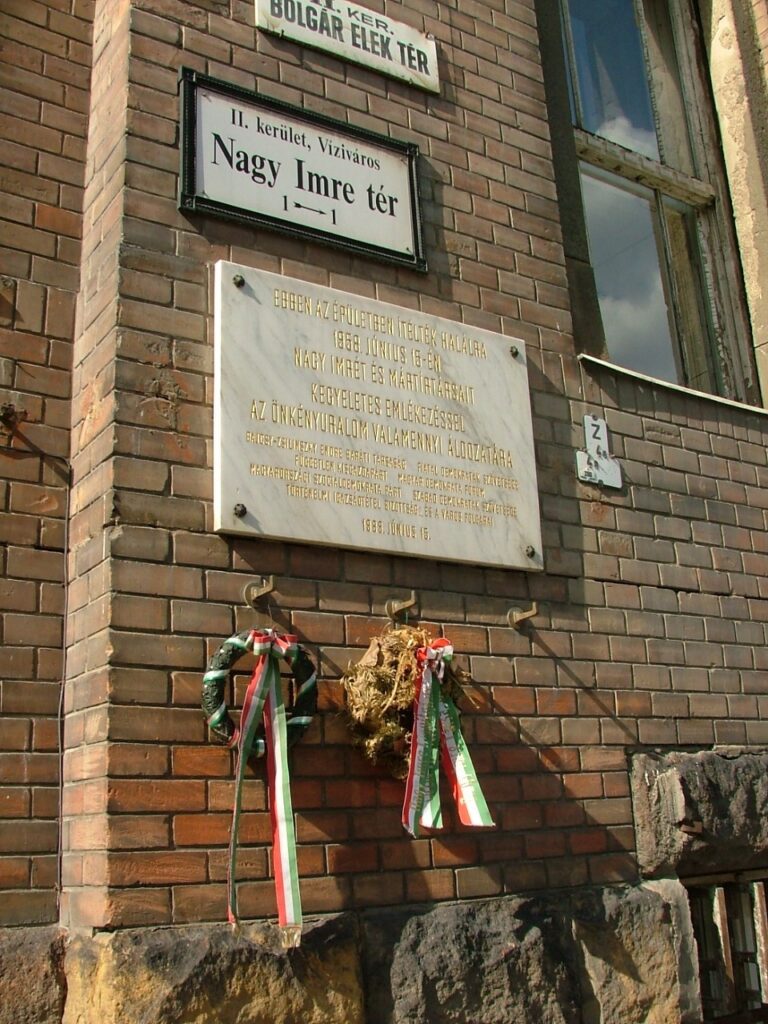
Die Gedenktafel zur Erinnerung an die Opfer des Prozesses vom 15. Juni 1958 wurde am 15. Juni 1989 an der Außenwand der heutigen Militärstaatsanwaltschaft angebracht. Initiiert wurde sie von verschiedenen Parteien und Verbänden.
Das Gefängnis an der Fő utca wurde 1915 als Gerichts- und Untersuchungshaftgebäude errichtet. Während der deutschen Besatzung 1944/45 residierte in den Räumen die Gestapo, nach der Befreiung Budapest übernahm die ungarische Staatssicherheit das Gebäude. Nach der Verbringung von Imre Nagy und anderen Anführern der Revolution nach Ungarn, wurden diese ab Mitte April 1957 in der Fő utca festgehalten. Für die Unterbringung wurde ein Zellentrakt geräumt und die Festgenommenen in strenger Einzelhaft gehalten. Während der Haft begann die Staats- und Parteiführung mit der Vorbereitung der Prozesse gegen die Führer der Revolution. Géza Losonczy, Minister in der Revolutionsregierung und enger Vertrauter Nagys, starb am 21. Dezember 1957 unter ungeklärten Umständen noch in der Untersuchungshaft. Am 5. Februar 1958 begann im gleichen Gebäude der Geheimprozess vor dem Militärgericht. Dieser wurde, auf Druck der sowjetischen Führung, bereits am zweiten Verhandlungstag ausgesetzt und erst am 9. Juni wieder aufgenommen. Nur Jószef Szilágyi, ein ehemaliger Polizeioffizier, wurde in einem Schnellverfahren zwischen dem 16. und 18. April 1957 verurteilt und am 24. April hingerichtet. Szilágyi hatte während des ersten Verhandlungstages heftige Angriffe gegen das Gericht und die Staatsanwaltschaft hervorgebracht, die die Durchführung des weiteren Prozesses aus Sicht der Parteiführung zu gefährden schienen. Am 15. Juni wurde Imre Nagy zum Tode verurteilt. Vor der Hinrichtung wurden er zusammen mit Pál Maléter und Miklós Gimes, die ebenfalls die Todesstrafe erhielten, in das Gefängnis an der Kozma utca verbracht und dort am nächsten Tag hingerichtet. Sándor Kopásci, Chef der Budapester Polizei und während der Revolution Führer der Nationalgarde, erhielt eine lebenslängliche Freiheitsstrafe. Die übrigen Angeklagten des Prozesses, Ferenc Donáth, Ferenc Jánosi, Zóltan Tildy und Miklos Vásárhelyi wurden zu längeren Gefängnisstrafen verurteilt.
Übersetzung (Englisch)
Memorial Plaque Commemorating the Victims of the Trial on June 15, 1958
One year later on June 15, 1989, the memorial plaque commemorating the victims of the trial on June 15, 1958 was installed on the exterior wall of the building currently used by the Military Public Prosecutor. The initiative originated from various parties and associations.
The prison in the Fő Street was erected for legal and criminal detention purposes in 1915. During German occupation in 1944/45, the Gestapo resided in the building, and after the liberation of Budapest, the Hungarian Secret Service took control of the premises. After Imre Nagy and other revolutionary leaders had been transported back to Hungary from Romania, they were held captive in the Fő Street from mid-April 1957. In order to accommodate the new prisoners, an entire cell block was vacated and the captives were kept in strict solitary confinement. During the term of imprisonment, the state and party leadership began preparations for the trial against the leaders of the Revolution. Géza Losonczy, a minister in the revolutionary government and a confidant of Nagy, died under mysterious circumstances while still in detention on December 21, 1957. On February 5, 1958 the secret trial before the military court began in the same building. Due to pressure from the Soviet leadership, the trail was interrupted on the second day of proceedings and first resumed on June 9th. Only Jószef Szilágyi, a former police officer, was condemned in a summary proceeding between April 16th and April 18th, 1957 and executed on April 24th. During the first day of the trial, Szilágyi had brought forth scathing attacks against the court and the public prosecutor, which in the view of the party leadership jeopardized the continuation of the trial. On June 15th Imre Nagy was sentenced to death. Before the execution, Nagy together with Pál Maléter and Miklós Gimes, both likewise sentenced to death, were brought to the prison in the Kozma Street and put to death the following day. Sándor Kopásci, Budapest Police Chief and leader of the National Guard during the Revolution, was sentenced to life imprisonment. The remaining defendants of the trial: Ferenc Donáth, Ferenc Jánosi, Zóltan Tildy and Miklos Vásárhelyi were sentenced to long-term imprisonment
Inschriften
Inschrift der Gedenktafel
(an der Gebäudefassade)
EBBEN AZ ÉPÜLETBEN TÉLTÉK HALÁLHA / 1958. JÚNIUS 15-ÉN / NAGY IMRE ÉS MARTÍRTÁRSAIT / KEGYELETES EMLÉKEZÉSSEL / AZ ÖNKÉNYURALOM VALAMENNYI ÁLDOZATÁRA / BAJOSY-ZSILINSKY ENDRE BARÁTI TÁNSÁSÁG PIATAL DEMOKRATÁK SZÖVETSÉGE / FÜGGETLEN KISZGAZDAPÁRT MAGYAR DEMOKRATA FÓRUM / MAGYARORSZÁGI SZOCIALDEMOKRATA PÁRT SZABAD DEMOKRATÁK SZÖVESÉGE / TÖRTÉNELMI IGASÓGTÉTEL BIZOTTSÁG ÉS A VÁROS POLGÁRAI / 1989. JÚNIUS 15.
Deutsche Übersetzung:
In diesem Gebäude wurden am 15. Juni 1958 Imre Nagy und seine Märtyrer-Kameraden zu Tode verurteilt. Würdevoll erinnern wir uns an alle Opfer der Gewaltherrschaft: Bajcsy-Zsilinszky Endre Freundschaftskreis, Verband der Jungdemokraten, unabhängige Partei der Kleinlandwirte, Ungarisches Demokratisches Forum, Sozialdemokratische Partei in Ungarn, Verband der Freien Demokraten, Komitee für Historische Gerechtigkeit und die Bürger der Stadt. 15. Juni 1989
In diesem Gebäude wurden am 15. Juni 1958 Imre Nagy und seine Märtyrer-Kameraden zu Tode verurteilt. Würdevoll erinnern wir uns an alle Opfer der Gewaltherrschaft: Bajcsy-Zsilinszky Endre Freundschaftskreis, Verband der Jungdemokraten, unabhängige Partei der Kleinlandwirte, Ungarisches Demokratisches Forum, Sozialdemokratische Partei in Ungarn, Verband der Freien Demokraten, Komitee für Historische Gerechtigkeit und die Bürger der Stadt. 15. Juni 1989
Englische Übersetzung:
In this building Imre Nagy and his martyr-comrades were sentenced to death on June 15, 1958. With great dignity we commemorate all victims of this reign of terror: Bajcsy-Zsilinszky Endre Friendship Circle, Association of Young Democrats, Independent Party of Smallholding Farmers, Hungarian Democratic Forum, Social Democratic Party in Hungary, Association of Free Democrats, Committee for Historical Justice and the Citizens of the City. June 15, 1989
In this building Imre Nagy and his martyr-comrades were sentenced to death on June 15, 1958. With great dignity we commemorate all victims of this reign of terror: Bajcsy-Zsilinszky Endre Friendship Circle, Association of Young Democrats, Independent Party of Smallholding Farmers, Hungarian Democratic Forum, Social Democratic Party in Hungary, Association of Free Democrats, Committee for Historical Justice and the Citizens of the City. June 15, 1989
Sprache: Ungarisch, Schrift: Lateinisch
Ereignisse
15. Juni 1989 - Einweihung
Einweihung der Gedenktafel zur Erinnerung an die Opfer des Prozesses vom 15. Juni 1958
Literatur
- Dent, Bob: Budapest 1956. Locations of Drama, Budapest 2006
- Dornbach, Alajos: The Secret Trial of Imre Nagy, Westport 1994
- Rainer, János: Imre Nagy. Vom Stalinisten zum Märtyrer des ungarischen Volksaufstands. Eine politische Biographie 1896 – 1958, Paderborn 2006
- 1956 enciklopédiája. A magyar forradalom és szabadságharc. 1956 október 6.- december 12, hrsg. vom 1956-os Intézet (1956-er Institut), Budapest 1999. 1 CD-ROM
- Kategorie: Gedenkort
- Historisch: Ja
- Standort: am Gebäude der Militärstaatsanwaltschaft, Nagy Imre tér 1
- Stadt: Budapest
- Ortsteil: II. Stadtbezirk
- Land: Ungarn
