

Budapest, Ungarn
Gedenktafel zur Erinnerung an die Gründung des Komitees für Historische Gerechtigkeit
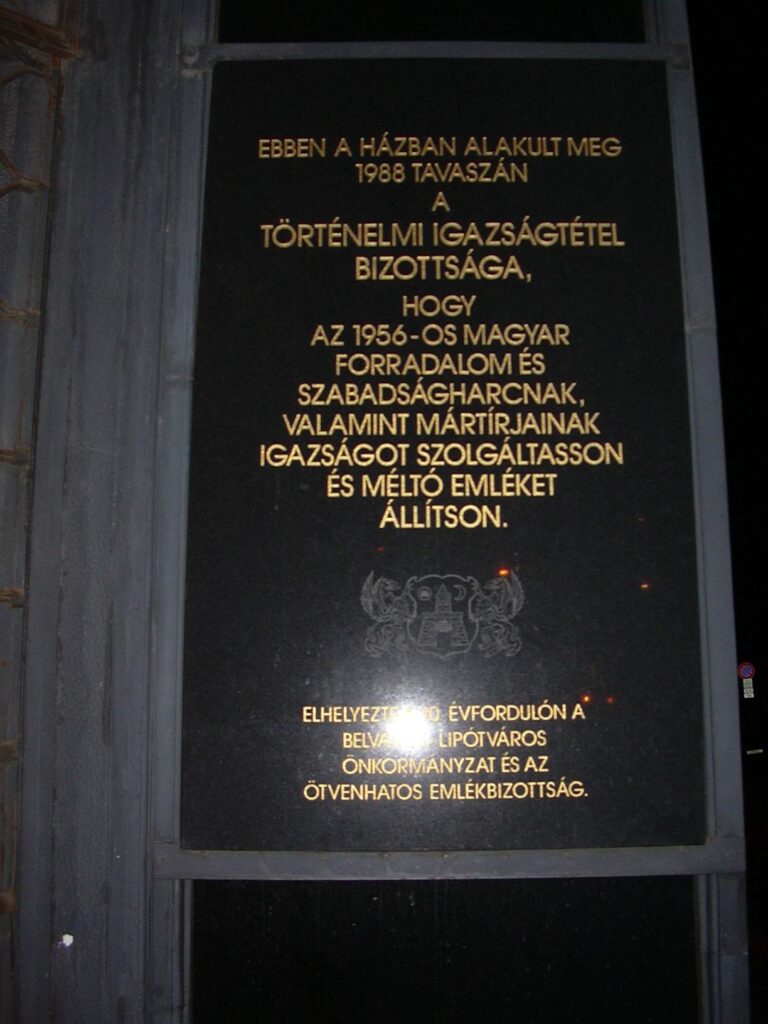
Die Gedenktafel zur Erinnerung an die Gründung des Komitees für Historische Gerechtigkeit wurde im Frühjahr 2001 an jenem Haus angebracht, in dem sich die Vereinigung im Frühjahr 1988 konstituierte. Initiiert wurde die Tafel von der Stadtbezirksverwaltung Belváros-Lipotváros sowie der Stiftung zum Andenken an die Revolution 1956. Die schwarze Platte aus poliertem Granit trägt eine dem Ereignis gewidmete Inschrift und zeigt das Wappen des Budapester Stadtbezirkes Belváros-Lipotváros (V. Stadtbezirk).
Zu Beginn der 1980er Jahren begann auf zivilgesellschaftlicher Ebene im Verborgenen die kritische Auseinandersetzung mit der Geschichte der Revolution von 1956, der offiziell als konterrevolutionäres Ereignis gebrandmarkt war. Eine kleine Gruppe ehemaliger Aufstandsteilnehmer sowie junge Geisteswissenschaftler, begannen um 1981 mit dem Aufbau eines Oral History Archivs, in dem die Erinnerungen von Zeitzeugen gesammelt wurden. Die ersten Listen mit den Opfern der Revolution kursierten so in der Mitte der 1980er Jahre als Samiszdat-Publikationen. 1986 konnte die Arbeit dieser Gruppen teilweise in legale Bahnen gelenkt und am Institut für Bildungsforschung fortgesetzt werden. Im gleichen Jahr fand eine erste halboffizielle Konferenz aus Anlass des 30. Jahrestages der Revolution statt, deren Teilnehmer sich aus allen Kreisen der ungarischen Opposition und Dissidentenbewegung rekrutierten. In den folgenden Jahren wurden erste Kontakte zu Zeitzeugen und Forschern in der westlichen Emigration geknüpft, die die Diskussion um eine Neubewertung der Ereignisse beförderte. Hauptanliegen war eine Rehabilitation der im Nachgang der Revolution verurteilten und stigmatisierten Leitfiguren der Erhebung, allen voran Imre Nagys. Aber auch das Gedenken an die zahlreichen anderen Opfer sollte in der Öffentlichkeit gepflegt werden können. Im Frühjahr 1988 gründete sich zu diesem Zweck das Komitee für Historische Gerechtigkeit. Aus Anlass des 30. Jahrestages der Hinrichtung Imre Nagys veröffentlichte es einen Aufruf, in dem die Rehabilitierung der Hingerichteten, ihre würdevolle Bestattung sowie die Neubewertung der Geschichte der jüngsten Vergangenheit und die Freigabe der Quellen und Materialien gefordert wurde, um eine unabhängige historische Forschung zu ermöglichen. Während der kommenden Monate spielten das Komitee und dessen Mitglieder eine wichtige Rolle. Besonders die Feierlichkeiten zur offiziellen Beisetzung Imre Nagys, Pál Maléters, Miklós Gimes’ und Géza Lozsoncys am 16. Juni 1989 waren ein wesentlicher Verdienst dieses Gremiums. 1991 ging aus dem Komitee für Historische Gerechtigkeit das Institut zur Erforschung der Revolution und des Freiheitskampfes 1956 (1956-er Institut) hervor.
Übersetzung (Englisch)
Memorial Plaque Commemorating the Foundation of the Committee for Historical Justice
In the early part of 2001, the memorial plaque commemorating the foundation of the Committee for Historical Justice was installed in the same house in which the formal constitution took place at the beginning of 1988. The plaque was initiated by the Municipal District Administration Belváros-Lipotváros together with the Foundation for the Commemoration of the 1956 Revolution. The black slab made of polished concrete bears an inscription dedicated to the occurrence and shows the coat-of-arms of the Budapest Municipal District Administration Belváros-Lipotváros (5th Municipal District).
At the onset of the 1980's, a critical reception dealing with the history of the 1965 Revolution began clandestinely in civilian circles, which had been officially classified as a counterrevolutionary event. Around 1981, a small group of former participants in the revolt as well as young scientists began to organise an Oral History Archive containing the testimonies of contemporaries. The first lists commemorating victims of the Revolution began circulating in the mid-1980's in the form of „Samiszdat“ publications. In 1986, it was possible for the group to operate on a partially legal basis, using the Institute for Educational Research as its base. During the same year, the first semi-official conference was held on the occasion of the 30th anniversary of the Revolution, for which participants from all sectors of the Hungarian opposition and resistance movement were able to be mobilised. In the coming years, initial contact was established with historical witnesses and researchers, who had emigrated to the west and who affirmed the need for a re-evaluation of the historical events. Their main focus was the rehabilitation of condemned and stigmatized figures who had led the uprising, Imre Nagy above all. Nonetheless, remembering all the numerous victims, and facilitating this, was viewed as a central public concern. For this purpose, the Committee for Historical Justice was founded in the early part of 1988. On the occasion of the 30th anniversary of the execution of Imre Nagy, the Committee published an appeal demanding the rehabilitation of those executed, their dignified burial, as well as a re-revaluation of recent historical occurrences and the release of the appropriate source materials required to undertake independent historical research. During the coming months, the Committee and its members played an important role. Especially the ceremonies surrounding the official burial of Imre Nagy, Pál Maléter, Miklós Gimes and Géza Lozsoncy on June 16, 1989 were chiefly a merit of this organisation. In 1991, the Committee for Historical Jus gave rise to the Institute for the Research of the 1956 Revolution and Fight for Freedom (the „1956 Institute“).
Inschriften
Inschrift der Gedenktafel
(an der Gebäudefassade)
EBBEN A HÁZBAN ALAKULT MEG / 1988 TAVASZÁN / A / TÖRTÉNELMI IGAZSÁGTÉTEL / BIZOTTSÁGA, / HOGY AZ 1956-OS MAGYAR / FORRADALOM ÉS SZABADSÁGHARCNAK, / VALAMINT MÁRTÍRJAINAK / IGAZSÁGOT SZOLGÁLTASSON / ÉS MÉLTÓ EMLÉKET / ÁLLÍTSON.
ELHELYZETTO ÉVFORDULÓN A / BELVÁROS LIPÓTVÁROS / ÖNKÖRMÁNYZAT ÉS AZ / ÖTVENHATOS EMLÉKBIZOTTSÁG.
Deutsche Übersetzung:
Um der ungarischen Revolution, dem Freiheitskampf und den Märtyrern Gerechtigkeit widerfahren zu lassen und um sie würdig in Erinnerung zu behalten, wurde im Frühling 1988 das Komitee für Historische Gerechtigkeit gegründet. Errichtet durch die Kommune Belváros-Lipótváros und das 56-er Gedenkkomittee im Jubiläumsjahr.
Um der ungarischen Revolution, dem Freiheitskampf und den Märtyrern Gerechtigkeit widerfahren zu lassen und um sie würdig in Erinnerung zu behalten, wurde im Frühling 1988 das Komitee für Historische Gerechtigkeit gegründet. Errichtet durch die Kommune Belváros-Lipótváros und das 56-er Gedenkkomittee im Jubiläumsjahr.
Englische Übersetzung:
In order to allow Justice to reign for the Hungarian Revolution, the Fight for Freedom and their Martyrs, and in order to commemorate them appropriately, the Committee for Historical Justice was founded in 1988. Erected by the District Commune Belváros-Lipótváros together with the 1956 Memorial Committee during the Annual Anniversary
In order to allow Justice to reign for the Hungarian Revolution, the Fight for Freedom and their Martyrs, and in order to commemorate them appropriately, the Committee for Historical Justice was founded in 1988. Erected by the District Commune Belváros-Lipótváros together with the 1956 Memorial Committee during the Annual Anniversary
Sprache: Ungarisch, Schrift: Lateinisch
Ereignisse
2001 - Einweihung
Einweihung der Gedenktafel zur Erinnerung an die Gründung des Komitees für Historische Gerechtigkeit
Literatur
- 1956 enciklopédiája. A magyar forradalom és szabadságharc. 1956 október 6.- december 12, hrsg. vom 1956-os Intézet (1956-er Institut), Budapest 1999. 1 CD-ROM
- Litván, György; Bak, János M. (Hrsg.): Die Ungarische Revolution 1956. Reform, Aufstand, Vergeltung, Wien 1994
- Kategorie: Gedenkort
- Historisch: Ja
- Standort: Gerlóczy utca
- Stadt: Budapest
- Ortsteil: V. Stadtbezirk
- Land: Ungarn
