

Budapest, Ungarn
Gedenktafel für die Führer des Nationalen Ungarischen Revolutionskomitees in Buda
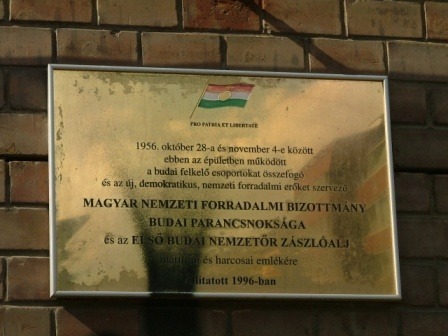
Die Gedenktafel für die Führer des Nationalen Ungarischen Revolutionskomitees wurde 1996 am Gebäude der heutigen Militärstaatsanwaltschaft angebracht.
Das Nationale Revolutionskomitee formierte sich am 29./30. Oktober 1956 unter der Führung von József Dudás in den Räumen der besetzten Parteizeitung „Szabád Nép“ am Blaha Lujza tér. Bereits zwei Tage zuvor, hatte sich auf einer Versammlung im II. Budapester Stadtbezirk, ein Nationalkomitee gebildet, dem ebenfalls Dudás vorstand. Dieses Gremium verabschiedete unter seiner Führung ein 25-Punkte-Programm, das zu den radikalsten der Revolution zählte. Dudás lehnt die Koalitionsregierung unter Imre Nagy ab und forderte die Bildung einer Koalitionsregierung unter Einbeziehung des Revolutionskomitees. Weiterhin umfasste es die Neutralität Ungarn, den Abzug der sowjetischen Truppen sowie die Durchsetzung der bürgerlichen Freiheiten und die Schaffung eines Mehrparteiensystems in Ungarn. Zur Durchsetzung dieser Ziele formierte sich eine etwa 400 Mann starke Gruppe um Dudás, die am 29. Oktober 1956 das Gebäude der größten Parteizeitung „Szabád Nép“ besetzte und dort ihr Hauptquartier aufschlug. Das Nationalkomitee gab sich fortan den die Bezeichnung Nationales Revolutionskomitee und brachte ab dem Morgen des 30. Oktober eine eigene Zeitung, „Magyar Függetlenség“ (Ungarische Unabhängigkeit) heraus, in der die Regierung unter Imre Nagy als illegitim bezeichnet wurde. Dudás bemühte sich um die Anerkennung des Revolutionskomitees als einzig legitime Regierung Ungarns bei den sowjetischen Militärbehörden und verhandelte nach deren Ablehnung auch mit Imre Nagy über die Bildung einer neuen Regierung. Dudás bemühte sich ebenfalls vergeblich um die Unterstützung anderer Revolutionskomitees in der Provinz, um eine Gegenregierung zu installieren. Jenseits der politischen Bemühungen war die Gruppe um Dudás für Verhaftung zahlreiche Funktionäre des ungarischen Staatssicherheitsdienstes ÁHV und des Parteiapparates verantwortlich. Dudás wurde aufgrund seiner kompromisslosen Haltung während der Revolution mit Zwischenfällen, wie der Erstürmung des Außenministeriums am 2. November oder einen versuchten Überfall auf die Nationalbank, in Verbindung gebracht und kurzzeitig verhaftet. Zum Bruch zwischen dem Revolutionskomitee und Dudás kam es am 4. November während des zweiten sowjetischen Einmarsches, da er sich nach anfänglichem Zögern weigerte, den sowjetischen Truppen Widerstand entgegenzusetzen. Er wurde daraufhin von seinen eigenen Mitstreitern festgesetzt, kurz darauf jedoch verwundet in ein Krankenhaus gebracht. Die verbliebenen Mitglieder der Gruppe setzten dem Kampf gegen die sowjetischen Truppen sporadisch bis zum 7./8. November 1956 am Blaha Lujza tér fort und lösten sich dann auf. Dudás wurde am 21. November unter dem Vorwand von Verhandlungen mit der Kádár-Regierung verhaftet. Am 14. Januar 1957 wurde er zusammen mit János Szabó, Anführer der Aufständischen auf dem Széna tér, von einem Sondergericht des Militärkollegiums des Obersten Gerichtshofes unter dem Vorwurf der Bildung einer Verschwörung zum Tode verurteilt. Ein Gnadengesuch wurde am 18. Januar abgelehnt. József Dudás wurde am folgenden Tag in Budapest hingerichtet. Sein Grab befindet sich auf der Parzelle 301 des Neuen Städtischen Friedhofs.
Übersetzung (Englisch)
Memorial Plaque for the Leaders of the National Hungarian National Committee in Buda
In 1996 the memorial plaque for the leaders of the National Hungarian Revolutionary Committee was installed at the building of the current Military Public Prosecutor.
The National Revolutionary Committee was first convened under the leadership of József Dudás on October 29th/30th, 1956 in the occupied premises of the official party newspaper „Szabád Nép“ at Blaha Lujza Square. Already two days prior to this, a National Committee had been formed during an assembly of the Second Municipal District of Budapest, also under the chairmanship of Dudás. Under his leadership, this Committee ratified a 25-point programme which ranks among the most radical of the Revolution. Dudás refused to participate in the coalition government under Imre Nagy, demanding the formation of a coalition government which would include the Revolutionary Committee. Unrelentingly, the Committee stood for Hungary's neutrality, the withdrawal of Soviet troops, as well as the enforcement of civil liberties for the bourgeoisie and the establishment of a multi-party system in Hungary. In order to champion these aims, a group of approximately 400 men formed around Dudás, stormed and occupied the offices of the largest party newspaper, „Szabád Nép“, and set up their headquarters there on October 29, 1956. The National Committee then renamed itself „National Revolutionary Committee“ and - after the morning of October 30th – began publishing its own newspaper „Magyar Függetlenség“ (Hungarian Independence), in which the government led by Imre Nagy was declared to be illegitimate. Dudás strove to obtain the recognition of the Soviet military authorities for the Revolutionary Committee as the sole legitimate government in Hungary, and subsequent to the rejection of this initiative, Dudás also negotiated with Imre Nagy for the purposes of forming a new government. Dudás likewise endeavoured to secure the support of Revolutionary Committees in the Hungarian provinces in order to establish a new national government. Beyond these political efforts, the group which had formed around Duás was also responsible for the arrest of numerous functionaries from the Hungarian Secret Service ÁHV and the party hierarchy. As a result of his uncompromising stance during the Revolution, Dudás was accused of implication in such occurrences such as the siege of the Foreign Ministry on November 2nd or an attempted attack on the National Bank, and was arrested for a brief period. During the second invasion of Soviet troops, it came to a break between Dudás and the Revolutionary Committee on November 4th, as he had hesitated, and then refused to resist the Soviet troops. Afterwards, he was detained by his own comrades, however, shortly thereafter he was brought to hospital in an injured condition. The remaining members of the group continued a sporadic fight against the Soviet troops at Blaha Lujza Square until November 7th/8th, 1956 and eventually disbanded. Under the pretext of negotiations with the Kádár government, Dudás was once again arrested on November 21st. On January 14, 1957 Dudás - together with János Szabo, leader of the insurgents at Széna tér – was accused of forming a conspiracy and sentenced to death by the Military Collegium of the Superior Court. A plea for clemency was refused on January 18th. József Dudás was executed the following day in Budapest. His grave is located in Lot 301 of the New Municipal Cemetery.
Inschriften
Inschrift der Gedenktafel
(an der Gebäudefassade)
PRO PATRIA ET LIBERTATE / 1956. OKTÓBER 28-A ÉS NOVEMBER 4-E KÖZÖTT / EBBEN AZ ÉPÜLETBEN MÜKÖDÖTTT / A BUDAI FELKELÖ CSOPORTOKAT ÖSSZEFOGÓ / ÉS AZ ÚJ, DEMOKRATIKUS, NEMZETI FORRDALMI ERÖKET SZERVEZÖ / MAGYAR NEMZETI FORRADALMI BIZOTTMÁNY / BUDAI PARANCSNOKSÁGA / ÉS AZ ELSÖ BUDAI NEMZETÖR ZÁSZLÓALJ / MÁRTIRIJA ÉS HARCOSAI EMLÉKÉRE / ÁLLITATOTT 1996-BAN
Deutsche Übersetzung:
Für Vaterland und Freiheit. Vom 28. Oktober bis zum 4. November 1956 befand sich in diesem Gebäude die Budaer Kommandantur des Ungarischen Nationalen Revolutionskomitees, welche die neuen demokratischen, nationalen Aufstandtruppen in Buda koordinierte, sowie das Erste Budaer Bataillon der Nationalgarde. Errichtet zur Erinnerung an die Märtyrer und Kämpfer im Jahre 1996
Für Vaterland und Freiheit. Vom 28. Oktober bis zum 4. November 1956 befand sich in diesem Gebäude die Budaer Kommandantur des Ungarischen Nationalen Revolutionskomitees, welche die neuen demokratischen, nationalen Aufstandtruppen in Buda koordinierte, sowie das Erste Budaer Bataillon der Nationalgarde. Errichtet zur Erinnerung an die Märtyrer und Kämpfer im Jahre 1996
Englische Übersetzung:
For Fatherland and Freedom. From October 28th until November 4th 1956, the Buda Headquarters of the Hungarian National Revolutionary Committee, which coordinated the new democratic and national resistance troops in Buda, as well as organising the First Buda Battalion of the Hungarian National Guard. Erected 1996 in memory of the martyrs and fighters
For Fatherland and Freedom. From October 28th until November 4th 1956, the Buda Headquarters of the Hungarian National Revolutionary Committee, which coordinated the new democratic and national resistance troops in Buda, as well as organising the First Buda Battalion of the Hungarian National Guard. Erected 1996 in memory of the martyrs and fighters
Sprache: Latein / Ungarisch, Schrift: Lateinisch
Ereignisse
1996 - Einweihung
Einweihung der Gedenktafel für die Führer des Nationalen Ungarischen Revolutionskomitees in Buda
Literatur
- Dent, Bob: Budapest 1956. Locations of Drama, Budapest 2006
- 1956 enciklopédiája. A magyar forradalom és szabadságharc. 1956 október 6.- december 12, hrsg. vom 1956-os Intézet (1956-er Institut), Budapest 1999. 1 CD-ROM
- Kategorie: Gedenkort
- Historisch: Ja
- Standort: am Gebäude der Militärstaatsanwaltschaft, Nagy Imre tér 1
- Stadt: Budapest
- Ortsteil: II. Stadtbezirk
- Land: Ungarn
