

Budapest, Ungarn
Gedenktafel für das Revolutionskomitee von Újpest
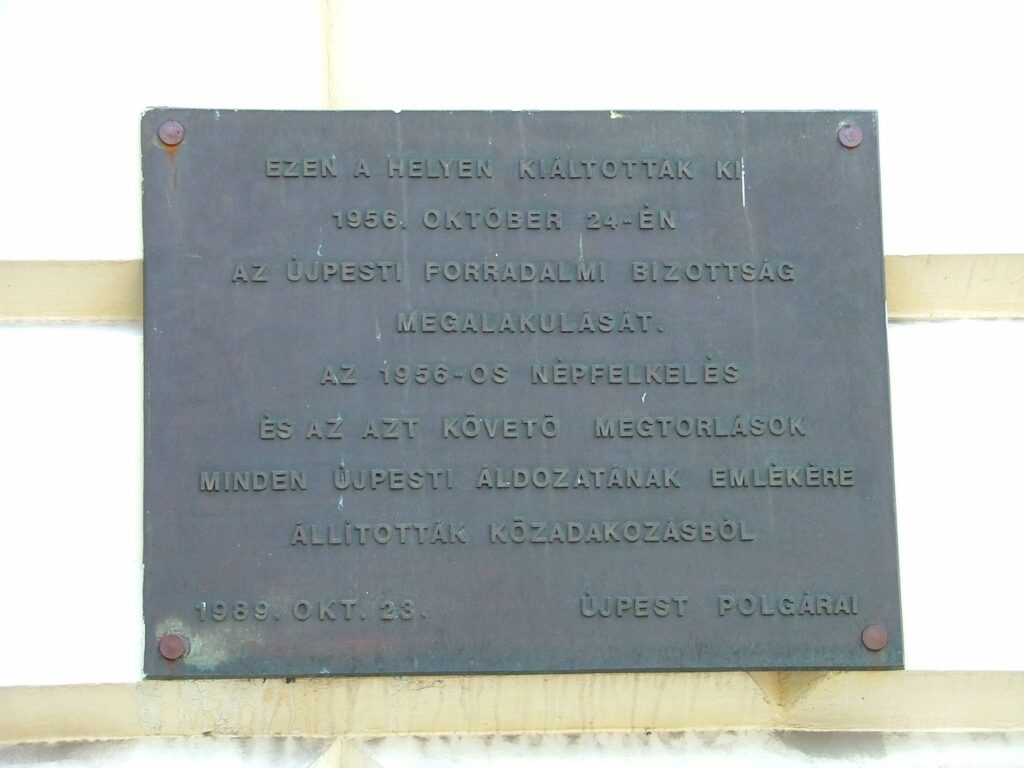
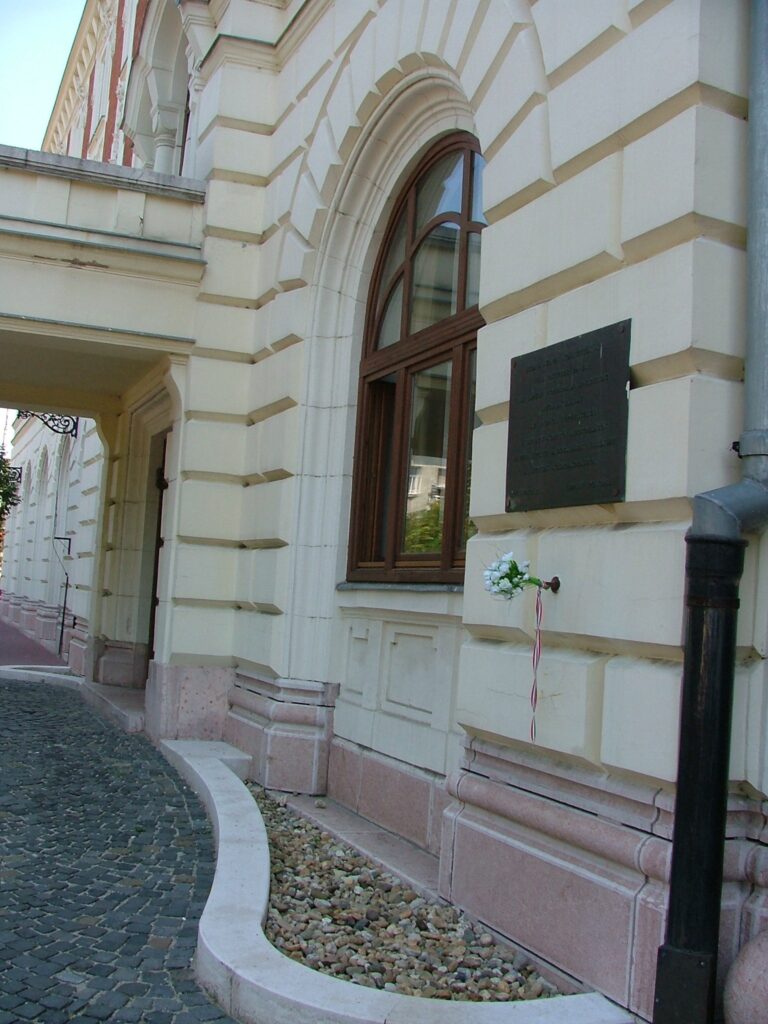
Die Gedenktafel für das Revolutionskomitee des Budapester Stadtbezirkes Újpest wurde am 23. Oktober 1989 an der Außenwand des Rathauses von Újpest angebracht. Finanziert wurde die Tafel aus Spenden ehemaliger Aufstandsteilnehmer und von Anwohnern.
Am 24. Oktober 1956, einen Tag nach den ersten großen Demonstration im Budapester Stadtzentrum, versammelten sich tausende Menschen vor dem Rathaus in Újpest. Am Morgen des gleiches Tages hatte sich in den benachbarten Vereinigten Elektrizitätswerken (Egyesült Izzó) der erste Arbeiterrat der Hauptstadt gebildet, der unter dem Eindruck der Ereignisse einen Forderungskatalog verfasst hatte. Dieser wurde von Pál Kósa, einem Zimmermann, vor den versammelten Demonstranten verlesen. Während der Kundgebung wurde ein spontan ein Revolutionskomitee gewählt, zu dessen Vorsitzenden Kósa berufen wurde. Dieses Gremium übernahm die Verwaltung des Stadtbezirkes und setzte die alte Administration ab. Ihm gehörten neben den gewählten Demonstranten auch Vertreter der größten Betriebe und Verbände an; in der Mehrzahl einfache Arbeiter. Auf Betreiben des Revolutionskomitees wurde eine bewaffnete Zivilgarde ins Leben gerufen, die für die Aufrechterhaltung der öffentlichen Sicherheit und Ordnung zu sorgen hatte. Einige Angehörige des ungarischen Staatssicherheitsdienstes, aber auch Parteifunktionäre und Betriebsdirektoren wurden daraufhin verhaftet und festgesetzt. Aufgrund dieser Bemühungen kam es in Újpest im Gegensatz zu anderen Stadtteilen nicht zu Selbstjustiz und Ausschreitungen, wie sie in jenen Tagen oft zu beobachten waren. Am 26. Oktober 1956 verabschiedete das Revolutionskomitee ein eigenes Programm, das neben der Einsetzung einer neuen Regierung unter Beteiligung der Aufständischen, dem Abzug der sowjetischen Truppen und der Neutralität Ungarns auch einen Generalstreik bis zur Durchsetzung dieser Ziele beinhaltete. Mit dem erneuten Einmarsch der sowjetischen Streitkräfte am 4. November 1956 nahm das Revolutionskomitee mit der Militärführung der Interventionstruppen Verbindung auf. Nach Verhandlungen gelang es, den sowjetischen Einmarsch in Újpest zunächst zu verhindern. Das Revolutionskomitee und die Zivilgarde behielten die Kontrolle über den Stadtbezirk, leisteten dafür aber den Truppen keinen Widerstand. Diese Waffenruhe hielt bis zum 8. November, als auch Újpest nach heftigen Kämpfen besetzt wurde. Das Revolutionskomitee blieb dennoch formal bis zum 12. November 1956 bestehen und verhandelte mit der wieder eingesetzten alten Administration über die Wiederherstellung der öffentlichen Sicherheit. Am Morgen des folgenden Tages wurden die Mitglieder jedoch von sowjetischen Truppen verhaftet. Die in den Betrieben gebildeten Arbeiterräte blieben bis Dezember 1956 bestehen, bevor sie auf Druck der neuen Regierung ebenfalls aufgelöst werden mussten. Mitte 1958 wurden die Anführer des Revolutionskomitees von Újpest schließlich abgeurteilt. Pál Kósa und sechs andere wurden zum Tode verurteilt und hingerichtet, mehr als zwanzig weitere erhielten lange Gefängnisstrafen.
Übersetzung (Englisch)
Memorial Plaque for the Revolutionary Committee of Újpest
The memorial plaque for the Revolutionary Committee of the Budapest Municipal District Újpest was installed on the exterior wall of the Újpest Town Hall on October 23, 1989. The plaque was financed by donations from former participants of the rebellion and city inhabitants.
One day following the first large-scale demonstration in the Budapest city centre – October 24, 1956 – thousands of people gathered before the Újpest Town Hall. During the morning of the same day, the first Workers' Council of the capital city had been formed at the neighbouring United Electricity Works (Egyesült Izzó), where a catalogue of demands had also been formulated in reaction to the most recent developments. Pál Kósa, a carpenter, read this catalogue aloud to the assembled demonstrators. During this rally, a Revolutionary Committee was spontaneously elected and Kósa was appointed as its chairman. This body assumed the administration of the municipal district, after having deposed the former municipal administration. Within this Committee – besides the demonstrators elected to various offices – were also representatives from the largest production operations and trade associations; simple workers constituted the majority. At the initiative of the Revolutionary Committee, an armed Civil Guard was established to enforce public security and maintain order. Several members of the Hungarian Secret Service, but also party functionaries and industrialists, were soon arrested and placed in detention. Due to these efforts, in contrast to what could often be observed in other municipal districts, Ùjpest did not become the scene of vigilante justice or other excesses. On October 26, 1956, the Revolutionary Committee ratified its own programme, which – along with plans to establish a new government with the participation of insurgents, the withdrawal of Soviet troops and the neutrality of the Hungarian state – also contained provisions for the organisation of a national strike until these demands had been met. After the renewed invasion of Soviet armed forces on November 4, 1956, the Revolutionary Committee succeeded in establishing contact with the military command of the invading forces. After negotiations, it was at first possible to halt the advance of Soviet troops into Újpest. The Revolutionary Committee and Civil Guard retained control of the municipal district, and were not forced to oppose the Soviet forces with military means. This truce lasted until November 8th, after which Újpest was also occupied in the wake of violent battles. Nonetheless, the Revolutionary Committee officially existed until November 12, 1956 and went on to hold negotiations with the formerly deposed but re-established state administration concerning the reinforcement of public order. In the morning of the following day, however, the members were arrested by Soviet troops. The Workers' Councils which had been established in the production centres continued to exist until December 1956, until they, too, were forced to dissolve under the pressures of the new government. In mid-1958, the leaders of the Revolutionary Committee of Újpest were finally condemned and sentenced. Pál Kósa and six other individuals were sentenced to death and executed, while more than twenty others received long prison sentences.
Inschriften
Inschrift der Gedenktafel
(an der Gebäudefassade)
EZEN A HELYEN KIÁLTOTTÁK KI / 1956. OKTÓBER 24.-ÉN / AZ ÚJPESTI FORRADALMI BIZOTTSÁG / MEGALAKULÁSÁT. / AZ 1956-OS NÉPFELKELÉS ÉS AZT KÖVETÖ MEGTORLÁSOK / MINDEN ÚJPESTI ÁLDOZATÁNAK EMLÉKÉRE / ÁLLÍTOTTÁK KÖZADAKOZÁSBÓL
1989. OKT. 23.
ÚJPEST POLGÁRAI
Deutsche Übersetzung:
An diesem Ort wurde 24. Oktober 1956 die Gründung des Revolutionskomitees in Újpest verkündet. Zum Gedenken an die Újpester Opfer des Volksaufstandes 1956 und der anschließenden Vergeltung. Errichtet aus öffentlichen Spenden. 23. Oktober 1989 Die Bürger von Újpest
An diesem Ort wurde 24. Oktober 1956 die Gründung des Revolutionskomitees in Újpest verkündet. Zum Gedenken an die Újpester Opfer des Volksaufstandes 1956 und der anschließenden Vergeltung. Errichtet aus öffentlichen Spenden. 23. Oktober 1989 Die Bürger von Újpest
Englische Übersetzung:
At this location the establishment of the Újpest Revolutionary Committee was announced on October 24, 1956. In memory of the Újpest victims of the 1956 Revolution and the ensuing retaliation. Erected with public donations. October 23, 1989 The Citizens of Újpest
At this location the establishment of the Újpest Revolutionary Committee was announced on October 24, 1956. In memory of the Újpest victims of the 1956 Revolution and the ensuing retaliation. Erected with public donations. October 23, 1989 The Citizens of Újpest
Sprache: Ungarisch, Schrift: Lateinisch
Ereignisse
23. Oktober 1989 - Einweihung
Einweihung der Gedenktafel für das Revolutionskomitee von Újpest
Literatur
- Dent, Bob: Budapest 1956. Locations of Drama, Budapest 2006
- Rainer, János M.: Helyi politikai szerveződés 1956-ban. Az újpesti példa. In: Kresalek, Gabor (Hrsg.): Az ostromtól a forradalomig, Budapest 1990
- 1956 enciklopédiája. A magyar forradalom és szabadságharc. 1956 október 6.- december 12, hrsg. vom 1956-os Intézet (1956-er Institut), Budapest 1999. 1 CD-ROM
- Kategorie: Gedenkort
- Historisch: Ja
- Standort: am Rathaus von Újpest, István tér 14
- Stadt: Budapest
- Ortsteil: IV. Stadtbezirk
- Land: Ungarn
