

Budapest, Ungarn
Denkmal für István Bibó
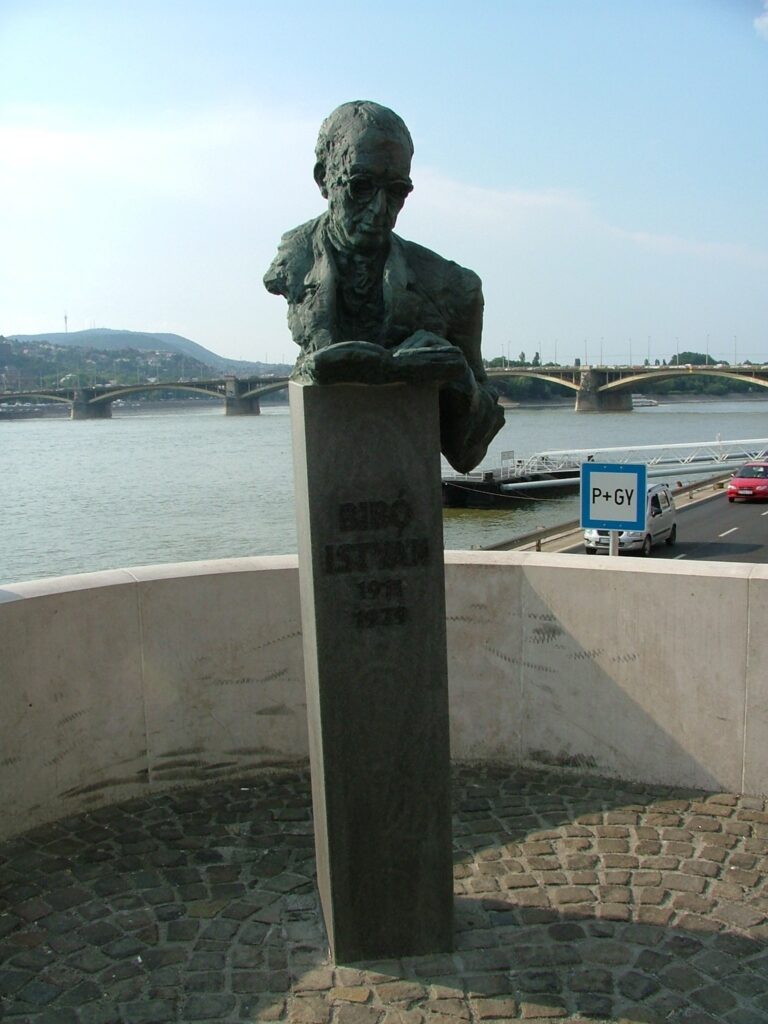
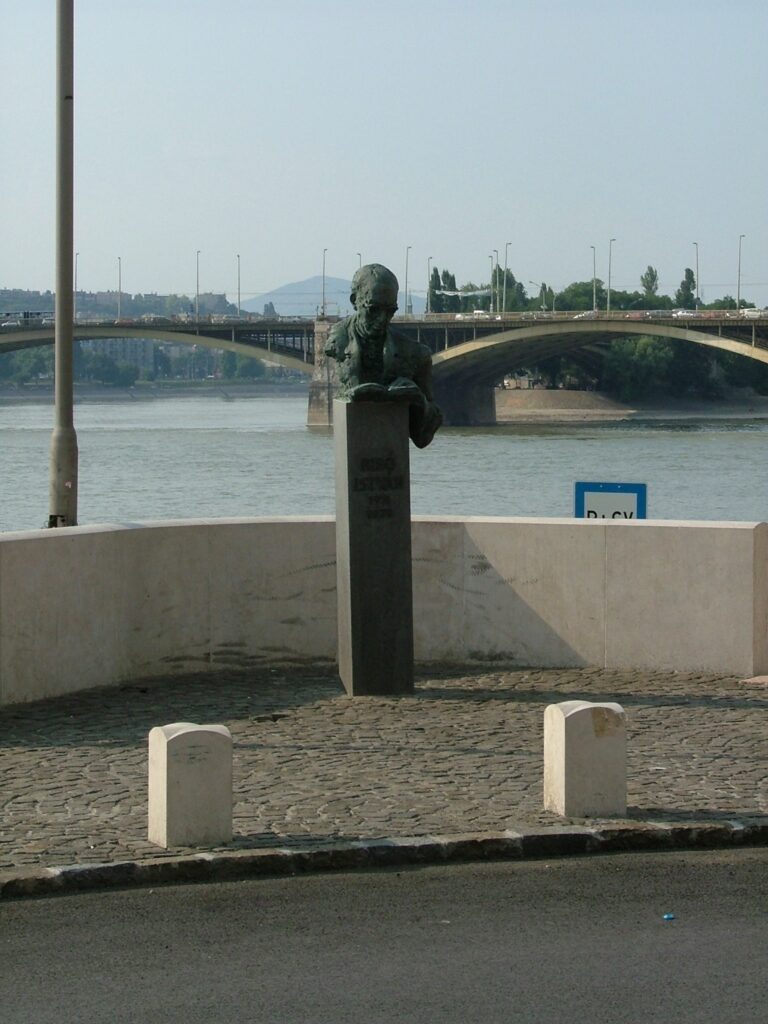
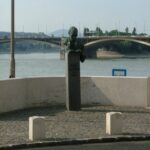
Das Denkmal zur Erinnerung an István Bibó befindet sich am Ufer der Donau auf dem Kossuth Lajos tér. Es wurde am 20. Mai 2005 eingeweiht. Die unauffällige Büste Bibós mit einer schreibenden Hand erinnert an seine Appelle an die westliche Staatengemeinschaft, die er am 4. November 1956 im Parlamentsgebäude verfasste, während sowjetische Truppen die Stadt besetzten.
István Bibó wurde am 7. August 1911 in Budapest geboren. Nach dem Besuch des Piaristenkollegs in Szeged nahm er 1929 ein Studium der Rechtswissenschaften an der dortigen Universität auf, dass er bis 1935 in Wien und Genova (Genua) fortsetzte. Nach seinem Abschluss arbeitete er als Anwalt am ungarischen Gerichtshof. 1938 wechselte er in das Justizministerium, 1940 habilitierte er sich. Politisch stand Bibó in der Zwischenkriegszeit der sozialdemokratischen Bewegung nahe und setzte sich kritisch mit dem Horthy-Regime in Ungarn auseinander. 1944 versuchte er nach der deutschen Besetzung des Landes die Deportation ungarischer Juden zu verhindern, in dem er an der Ausstellung von Schutzbriefen des Justizministeriums beteiligt war. Im Oktober 1944 wurde Bibó vorübergehend von dem faschistischen Pfeilkreuzlerregime verhaftet. Nach der Befreiung Budapests im Februar 1945 nahm er einen Posten im Innenministerium der Provisorischen Regierung an, in dem er bis 1946 verblieb. An der Universität Szeged hatte Bibó bis 1950 eine Professur inne, ab 1946 war er zudem Mitglied der Akademie der Wissenschaften. Zeitgleich war er Mitbegründer der linksgerichteten Nationalen Bauernpartei, in der er bis zur Gleichschaltung der Parteienlandschaft 1949 wirkte. Seine Schriften, in denen er für einen „Dritten Weg“ der mittelosteuropäischen Staaten jenseits des sowjetischen Kommunismusmodells aber auch in klarer Abgrenzung zur westlichen Demokratie stritt, fanden in den Nachkriegsjahren breite Aufmerksamkeit. 1950 wurde Bibó all seiner Posten enthoben und arbeitete fortan als Bibliothekar an der Budapester Universität. Mit dem politischen Reformkurs Anfang 1956 schloss er sich dem Petőfi-Kreis an und nahm damit eine bedeutende Rolle bei den intellektuellen Kontroversen jener Monate ein. Imre Nagy ernannte Bibó am 3. November 1956 zum Minister seiner Regierung. Als am folgenden Tag die sowjetischen Truppen in Budapest einmarschierten, verblieb Bibó als einziger Minister im Parlamentsgebäude. Dort verfasste er Appelle an die Vereinten Nationen, in denen er um Beistand für Ungarn bat. Diese Aufrufe gelangten später in den Westen und erregten dort große Aufmerksamkeit. Nach der Niederschlagung der Revolution blieb Bibó zunächst unbehelligt und verhandelte mit der Kádár-Regierung um die Aufnahme von Nicht-Kommunisten in die neue Regierung. Währenddessen verfasste er weitere Schriften, die sich mit der Lage Ungarns auseinandersetzten. Nachdem eine Abhandlung von Bibó im Frühjahr 1957 in den Westen gelangte, wurde er am 23. Mai vom ungarischen Staatssicherheitsdienst verhaftet. Am 2. August 1958 verurteilte ihn der Oberste Gerichtshof zu einer lebenslänglichen Freiheitsstrafe. Bibó setzte seinen Protest auch während der Haft fort, indem er sich einem Hungerstreik inhaftierter Anführer der Revolution im Gefängnis von Vác anschloss. Das westliche Ausland drängte die ungarische Regierung unterdessen immer wieder, Bibó freizulassen. Doch erst im März 1963 wurde er im Zuge der Amnestie entlassen. Bibó nahm eine Stelle als Bibliothekar im Zentralen Statistikamt an, wo er bis zu seiner Rente 1971 arbeitete. 1976 gelang es ihm noch einmal unter Umgehung der Behörden ein Buch im Westen zu veröffentlichen, bevor Bibó am 10. Mai 1979 nach längerer Krankheit in Budapest verstarb.
Übersetzung (Englisch)
Monument for István Bibó
The monument in memory of István Bibó is located at Kossuth Lajos Square, at the banks of the Danube. It was dedicated on May 20, 2005. The unimposing bust of Bibós with a writing hand recalls his appeal to the community of westerns states, which he had composed in the Parliament Building on November 4, 1956, as Soviet troops were occupying the city.
István Bibó was born in Budapest on August 7, 1911. After attending the Piarist College in Szeged, he began law studies at the local university there in 1929, later continuing the same in both Vienna and Genua until 1935. Following graduation, Bibó worked as an attorney for the Hungarian Court of Justice. In 1938, he moved on to the Ministry of Justice. In 1940, he acquired the right to teach at institutions of higher learning (Habilitation). Politically, Bibó had strong sympathies for the Social Democratic movement during the interim between the wars, and took a critical stance in respect to the Horthy regime in Hungary. In 1944, after German troops had occupied the country, Bibó attempted to prevent the deportation of Hungarian Jews by supporting the letters of protection issued by the Ministry of Justice. For a brief period, he was arrested by the fascist Arrow Cross regime. After the liberation of Budapest, Bibó took on a position at the Ministry of the Interior for the Provisional Government in February 1945, remaining there until 1946. Until 1950, he maintained his professorship at the University of Szeged, and after 1946 he was also a member of the Academy of Sciences. At the same time, Bibó was a co-founder of the left-wing National Farmers' Party, for which he was active until the levelling of the party landscape in 1949. His writings, in which he fought for a „Third Way“ for the central European states beyond the Soviet Communist schema yet clearly distinct from western-style democratic models, were widely influential during the post-war period. Bibó was relieved of all duties in 1950, and was then employed as a librarian at the University of Budapest. With the onset of political reforms at the beginning of 1956, he joined forces with the Petófi Circle, and thus, assumed a position of intellectual authority during the controversies of that period. On November 3, 1956 Bibó was appointed Minister in the new government by Imre Nagy. As the Soviet troops were invading Budapest the following day, Bibó was the only minister who had remained in the Parliament Building. From there, he sent out appeals to the United Nations, hoping to gain support for Hungary. These appeals later reached western governments and aroused great attention. After the Revolution had been defeated, Bibó remained at first undisturbed and was able to negotiate with the Kádár regime concerning the inclusion of non-Communists in the new government. In the meantime, he also continued his critical writings on the current status of the Hungarian state. After an essay from Bibó managed to reach the west in the early part of 1957, Bibó was arrested by the Hungarian Secret Service on May 23rd. On August 2, 1958, he was sentenced to life-long imprisonment by the Superior Court. Even during his incarceration, Bibó continued his protest by participating in a hunger strike organised by revolutionary leaders held at the Vác prison. Western nations pressured the Hungarian government to free Bibó on repeated occasions. In March 1963, he was indeed set free in the wake of the general amnesty. Bibó accepted a position at the Central Bureau of Statistics as a librarian, where he worked until his retirement in 1971. in 1976, Bibó was once again successful in thwarting the authorities in order to publish a book in the west, prior to his death after a prolonged illness on May 10, 1979.
Inschriften
Inschrift des Denkmals
(auf dem Sockel)
Bibó
István
1911
1979
Deutsche Übersetzung:
István Bibó 1911 1979
István Bibó 1911 1979
Englische Übersetzung:
Bibó István 1911 1979
Bibó István 1911 1979
Sprache: Ungarisch, Schrift: Lateinisch
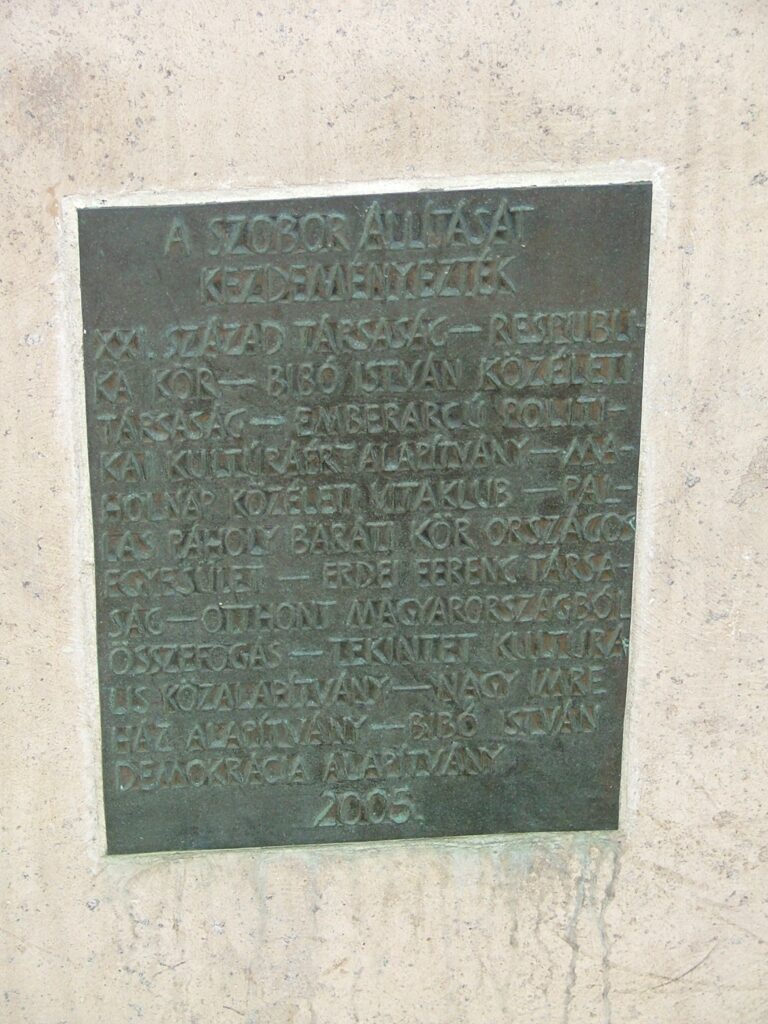
Inschrift der Gedenktafel
(an der Kaimauer)
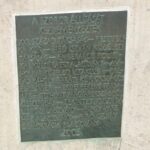
A SZBOR ÁLLÍTÁSÁT / KEZDEMÉNYEZTÉK / XXI. SZÁZAD TÁRSASÁG - RESPUBLI- / KA KÖR - BIBÓ ISTVÁN KÖZÉLETI- / TÁRSASÁG - EMBERARCÚ POLITI- / KAI KULTÚRAERT ALAPÍTVÁNY - MA- / HOLNAP KÖZÉLETI VITAKLUB - PAL- / LAS PÁHOLK BARÁTI KÖR ORSZAGOS / EGYSÜLET - ERDEI FERENC TÁRSA- / SÁG - OTTHONT MAGYARORSZÁGBÓL / ÖSSZEFOGÁS - TEKINTET KULTÚRA- / LIS KÖZALAPÍTVÁNY - NAGY IMRE / HÁZ ALAPÍTVÁNY - BIBÓ ISTVÁN / DEMOKRÁCIA ALAPÍTVÁNY / 2005
Deutsche Übersetzung:
Die Errichtung der Statue veranlassten die die Gesellschaft 21. Jahrhundert, der Kreis Respublika, die István Bibó Gesellschaft des öffentlichen Lebens, die Stiftung für bürgernahe politische Kultur, der Diskussionskreis „Morgen“, der Landesverband des Freundschaftkreises „Pallas Loge“, die Erdei Ferenc Gesellschaft, der Zusammenschluß "Aus Ungarn ein zu Hause machen", die Kulturstiftung „Blick“, die Stiftung Imre Nagy-Haus und die István Bibó Demokratiestiftung. 2005
Die Errichtung der Statue veranlassten die die Gesellschaft 21. Jahrhundert, der Kreis Respublika, die István Bibó Gesellschaft des öffentlichen Lebens, die Stiftung für bürgernahe politische Kultur, der Diskussionskreis „Morgen“, der Landesverband des Freundschaftkreises „Pallas Loge“, die Erdei Ferenc Gesellschaft, der Zusammenschluß "Aus Ungarn ein zu Hause machen", die Kulturstiftung „Blick“, die Stiftung Imre Nagy-Haus und die István Bibó Demokratiestiftung. 2005
Englische Übersetzung:
The erection of this statue was initiated by the 21st Century Society, the Circle „Res Publica“, the István Szabo Society of Public Life, the Foundation for the Furthering of Citizen Participation in Political Life, the discussion round „Tomorrow“, the local chapter of the friendship circle „Pallas Loge“, the Erdei Ferenc Society, the alliance between „Making Hungary a Home“, the cultural foundation „Look“, the Imre Nagy Memorial House and the István Bibó Democratic Foundation. 2005
The erection of this statue was initiated by the 21st Century Society, the Circle „Res Publica“, the István Szabo Society of Public Life, the Foundation for the Furthering of Citizen Participation in Political Life, the discussion round „Tomorrow“, the local chapter of the friendship circle „Pallas Loge“, the Erdei Ferenc Society, the alliance between „Making Hungary a Home“, the cultural foundation „Look“, the Imre Nagy Memorial House and the István Bibó Democratic Foundation. 2005
Sprache: Ungarisch, Schrift: Lateinisch
Ereignisse
20. Mai 2005 - Einweihung
Einweihung des Denkmals für István Bibó
Literatur
- Litván, György; Bak, János M. (Hrsg.): Die Ungarische Revolution 1956. Reform, Aufstand, Vergeltung, Wien 1994
- Dent, Bob: Budapest 1956. Locations of Drama, Budapest 2006
- 1956 enciklopédiája. A magyar forradalom és szabadságharc. 1956 október 6.- december 12, hrsg. vom 1956-os Intézet (1956-er Institut), Budapest 1999. 1 CD-ROM
- Kategorie: Gedenkort
- Historisch: Unbekannt
- Standort: am Donaukai, Kossuth Lajos tér
- Stadt: Budapest
- Ortsteil: V. Stadtbezirk
- Land: Ungarn
